Monday, March 31, 2014

Protecting Your Proprietary Information

Q.  What safeguards do you have in place to protect my most prized possessions – my recipes?

This is a great question and unfortunately, it is one that many co-packers have to answer. 

The first thing is that you are protected by the law under   According to wikipedia – “Intellectual property (IP) are the legally recognized exclusive rights to creations of the mind.  Under intellectual property law, owners are granted certain exclusive rights to a variety of intangible assets, such as musical, literary, and artistic works; discoveries and inventions; and words, phrases, symbols, and designs. Common types of intellectual property rights include copyright, trademarks, patents, industrial design rights, trade dress, and in some jurisdictions trade secrets.”

In addition we mutually sign a Non-Disclosure Agreement (NDA) that covers us under the stated trade secret laws.  So, in essence, NOT protecting your intellectual property is against the law. 

Having said that, however, the main reason you can trust in FoodProductLaunch.com is that we have been in the same place that you are in now.  We understand your nervousness in sharing your baby with somebody else.  We understand the importance of your intellectual property.   Our goal and our mission is to protect your trade secrets as if we are protecting our own.

This decision is a big decision for you and you should be as cautious as you possibly can.

Thanks for your great question! 

FoodProductLaunch.com is your trusted partner in helping you go from your kitchen to the marketplace with condiments, dressings, marinades, salsas, and sauces. 

TJ Gallivan

© foodproductlaunch.com 2014 All Rights Reserved.  We encourage you to repost this blog in its entirety.  If you choose to use portions of it…give credit where credit is due.

Tuesday, March 18, 2014

Recipe–Corned Beef and Cabbage Dinner

Q.  What’s your favorite meal?

Hmmm…that’s a tough one, because I do like to eat and I have many a favorite food, including pizza, wings, pasta and red sauce con frutti de mare,  but since it’s the day after the Feast of St. Patrick, aka St. Paddy’s day, I think I’ll go with Corned Beef and cabbage.

CB&CAccording to Wikipedia, Corned beef and cabbage is the Irish-American variant of the genuinely Irish dish of bacon and cabbage. A similar dish is the New England boiled dinner, consisting of corned beef, cabbage, and root vegetables such as carrots, turnips, and potatoes, which is popular in New England and parts of Atlantic Canada.

The appearance of corned beef in Irish cuisine dates to the 12th century in the poem Aislinge Meic Con Glinne or The Vision of MacConglinne.

I really enjoy making this dish myself and it’s a dish my mother would make every year for the 10 or so people she had to cook for each and every day.  I added a mustard glaze about 15 years ago.

I originally posted this recipe on Cookerati about 100 years ago and thought I would post it here.

Ingredients

  • 4.5 to 5 pound corned beef brisket, trimmed of fat
  • 1 whole garlic clove
  • 10 black peppercorns
  • 2 bay leaves
  • 8 or so carrots, peeled and cut into large pieces
  • 8 or so potatoes, cubed – I leave the skin on
  • 1 large Vidalia onion, quartered
  • 1 head cabbage, cut into wedges
  • butter

Mustard Glaze Ingredients

  • 1/2 cup Dijon mustard
  • 1/2 cup lightly packed brown sugar
  • 2 tablespoons dry mustard
  • 3 tablespoons red wine vinegar
  • 1/4 cup water
  • 1 tablespoon vegetable oil

Method

  1. In a large pot, cover brisket with water. Over high heat, bring to boil. Reduce heat and simmer for 5 minutes. Skim junk off top. Add garlic, peppercorns and bay leaves. Simmer covered for 2 1/2 to 3 hours.  Alternative…wake up early in the morning and instead of a large pot, put all of those ingredients in a slow cooker/crockpot on high for 6 hours.
  2. Add carrots, potatoes and onions. Cook until almost tender (20-25 minutes). Add cabbage and cook until all vegetables are tender.  If you used a slow cooker to cook the meat, transfer the liquid to a large pot and add the veggies.
  3. Do this step while the vegetables are cooking:
    1. Preheat broiler.
    2. Make mustard glaze –
      1. Combine Dijon mustard and brown sugar to make a paste.
      2. Whisk in the rest of the mustard glaze ingredients.
  4. Do this step while the cabbage is cooking:
    1. Remove brisket before putting cabbage in the pot.
    2. Place brisket fat side up on a rack over a broiler pan. Brush top of brisket with some of the mustard glaze. Put the brisket in the broiler so that the top of the brisket is about 6 inches from the heat. Broil 10 minutes, brushing meat several times with the glaze until the meat is shiny. Transfer meat to a cutting board and pour leftover glaze in serving board.
  5. Slice brisket and arrange on large serving platter.
  6. Using a slotted spoon to scoop out of the pot, place cabbage, carrots, and onions on the platter.
  7. Drain the potatoes, return them to the pot. Toss potatoes with butter and parsley and place on platter. [or you can just put all the vegetables in a serving bowl and let your guests do the butter and parsley thing].

NOTE:  I’m seriously considering going through the process of manufacturing the mustard glaze.  Would you purchase it if it was on the market?

Don’t forget to check out the full services that we offer at FoodProductLaunch.com to help you take your product from Your Kitchen to the Marketplace!

TJ Gallivan

© foodproductlaunch.com 2014 All Rights Reserved.  We encourage you to repost this blog in its entirety.  If you choose to use portions of it…give credit where credit is due.

Saturday, March 8, 2014

How Do I Make Pepper Mash?

Q.  In your last blog, you told us what aged peppers are.  How do I make my own pepper mash?

I’m happy to hear that I piqued your interest.  Making pepper mash is pretty straightforward.  It’s a bit of work in the preparation, but it’s all about Mother Nature doing her job.

The first thing you need to do is decide what kind of pepper mash you want to make.  This totally depends on your preference.  My first mash was made from jalapeños – both green and red – because those peppers are plentiful here in Florida. 

Step 1 – Mise en Place
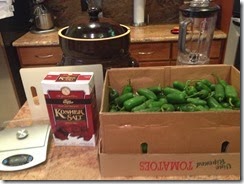
IMG_0479

The only ingredients you need to make pepper mash are non-iodized salt (I prefer Kosher salt) and peppers. 

That’s it.

The tools you will need are a kitchen scale, a blender or food processor, a cutting board, a sharp knife and a fermenting pot.   I’ve pictured my fermenting pot, which is high end, but you can get a one gallon glass mason jar from Target or WalMart for about $15.  

One gallon is about 8 pounds.  With a one gallon fermenting jar, you will be able to process no more than 50% to allow room for the peppers to ferment.  So, 4 pounds. 

Gloves!  Don’t forget gloves.  I recommend you not handle hot peppers with your bare hands, especially those peppers that are higher up on the Scoville scale!

Step 2 – Process the Peppers
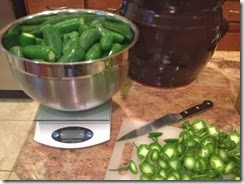
IMG_0480

The peppers need to be rinsed and then the stems need to be cut off the top of each pepper you want to process. 

The peppers need to be weighed, so you will know how much salt to add to the mix. 

One word of caution that I have had the misfortune to experience first hand…DO NOT ITCH ANY SENSITIVE BODY PARTS!  I hope this needs no further explanation. 

Step 3 – The Salt
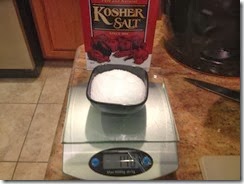
IMG_0481

Salt has been used for flavoring and preservation since Biblical times and it’s extremely important.  In my preservation process, I use a 6% salt to 94% pepper ratio. 

What this translates to is one ounce of salt to one pound of peppers ratio. 

For those using the metric system, this equates to 62 grams of salt to one kilogram of peppers. 

Some folks use helpers like yeast to get the fermentation process going quickly, but I prefer not to.  However, I have used an already fermented mash as an additive to a new batch to jump start the fermentation process.

Step 3 – Mixing the Ingredients

IMG_0483

I try and layer the peppers and salt as I mix them in the blender and since this was my first attempt, I cut the peppers in thirds AFTER I had cut the stems off.  You may want to do this WHILE you’re cutting the stems off. 

Seeds are one other thing that is purely a personal preference.  I left them in and pureed them in the process.  Some people cut them out before the blending process.

Since the peppers are solid right now, you may want to push them into the blades with a wooden spoon from the top to blend them better. IMG_0484 Be careful not to push too deep into the blender!  You don’t want splinters in your mash.

The green jalapeños turn a nice shade of mint green as you process them.  I added the peppers and the salt to the mix as I was blending, making sure the ratio remained constant throughout the blending process.  Also, I wanted a smoother mash, so I pretty much liquefied the peppers with the salt. 

IMG_0487

I tried to blend as much as I possibly could together mainly because I had a half a bushel of peppers to process. 

The end result of the mixing process was a very nice and smooth milkshake of peppers and salt which was then poured into the fermenting pot to begin the natural aging process.IMG_0489
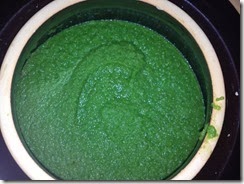
 

I had about 20 pounds of peppers and used 20 ounces (1.25 pounds) of salt to process.  I’ve seen ratios of up to 10% salt (so this batch would have called for 2 pounds of salt), but I wouldn’t go lower than 6%. 

The salt content will affect the flavor of the product you’re using the mash for, so you’ll have to adjust your follow-on recipe accordingly, if that recipe called for fresh peppers.

Now, all you need to do is cover the fermentation crock or jar loosely and let sit.  That’s it for the pepper processing.  Now it’s up to Mother nature.

Step 4 – Fermentation

IMG_0478

DISCLAIMER:  THE PEPPERS PICTURED TO THE LEFT ARE NOT THE SAME AS THE ONES ABOVE!  THIS PICTURE IS USED TO ILLUSTRATE THE FERMENTATION PROCESS.

The red jalapeños pictured are fermenting nicely.  This is how they should look after a week or so of fermenting.  It’s about 60% peppers floating to the top and 40% liquid at the bottom.

Every day once a day and no more than that you will need to stir the pot in order to blend the mixture.  You will be tempted to stir it more often, but please don’t as this will retard the fermentation process.

It does look pretty cool, doesn’t it?

The fermentation process is complete when you wake up one morning and there isn’t any separation.

Step 5 – The Finished Product
IMG_0503

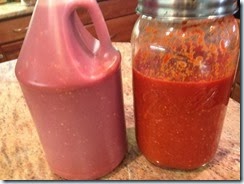
While the mash is fermenting it takes on a different color.  It doesn’t have that same vibrant color as the beautiful ripe red jalapeños we started with, but it has its own beauty. 

The yield or amount of mash you will get is totally dependent on the pepper you used.  A thick skinned pepper like the jalapeño will yield almost a one to one ratio of peppers started with to mash yielded. 

Thinner skinned peppers, such as habaneros, will yield much less.

Now, you are ready to create your very own aged pepper hot sauce!  For a simple hot sauce recipe, just mix it with vinegar to get to the thickness you desire.  For a more exotic sauce, experiment with different spices, fruits and vegetables to come up with your own specialty hot sauce.  If you use fresh fruits or vegetables in your recipe, you will have to cook the sauce in order to kill any harmful bacteria.

Don’t forget to contact FoodProductLaunch.com when you’re ready to go from Your Kitchen to the Marketplace.  We’ll do all the steps necessary to get you there!

TJ Gallivan

© foodproductlaunch.com 2014 All Rights Reserved.  We encourage you to repost this blog in its entirety.  If you choose to use portions of it…give credit where credit is due.

Aged Peppers–Say What?

Q.  On commercially available hot pepper sauces, the first ingredient usually is “Aged Hot Peppers”.  What does that mean? 

mash and pepper sauceExcellent question! 

Most pepper sauce companies use aged peppers as the first ingredient in their product.  The peppers are fermented similar to how pickles and sauerkraut are.  The reason for this is fairly simple.  Back in the old days when we were an agrarian society – meaning we were mostly farmers - it was how vegetables were preserved to extend their life after a bountiful harvest.

Fermented or aged hot peppers are no different.  The process is a little bit different than canning pickles or making sauerkraut, but the concept is the same.  We use salt and the water found naturally in peppers to create a good bacteria to preserve them.  The length of fermentation time varies from months to years.  For the datil pepper hot sauce pictured to the right above, I used the aged peppers (picture to the left) after about 6 months.  The McIlhenny Company ages their tabasco peppers in wooden casks from the Jack Daniels Company for over three years!  That’s how they achieve the unique Tabasco brand hot sauce flavor.

The finished fermented hot pepper product is called mash (like the corn mash used to make moonshine).  Then we use this mash with vinegar and other spices/vegetables to create a sauce that can be used as a condiment.  Tabasco, Frank’s, Cholula, and most other major hot sauce manufacturers use the same or similar process.

At FoodProductLaunch.com, on our private label hot sauces and in our jams and chutneys, and for our customers,  we use commercially available pepper mash from a well respected vendor – the Louisiana Pepper Exchange.  They strive to make the most consistent pepper mashes in terms of flavor, texture and availability.

Please contact us to go through the Research & Development Process to go From Your Kitchen to the Marketplace.

TJ Gallivan

© foodproductlaunch.com 2014 All Rights Reserved.  We encourage you to repost this blog in its entirety.  If you choose to use portions of it…give credit where credit is due.

Helping Chefs, Restaurant Owners and Restauranteurs

Q.  I’m an executive chef and I run my own restaurant.  How exactly do your services  help me?

I am really glad you asked because sometimes it seems as if that’s counterintuitive. 

We believe that there are many ways that FoodProductLaunch.com’s Research & Development and Manufacturing services can help chefs and restauranteurs or restaurant owners.  And I’m sure that there are a few more, but I’ll talk about the reasons that jumped out at us when we put together our Concept of Operations and business plan. 

We help you by taking the making of your sauce out of your hands!  

Tommy with dishI think before we discuss the ways we can help, we need to discuss some examples of the issues that restaurant owners and chefs encounter fairly frequently. 

- You’ve created a signature house dressing and there are times when you’re not there to make it.  You assign the making of the dressing to one of your employees, who is not as diligent about the ingredients as you are and isn’t as concerned about the flavor or texture as you are.  The days that he makes the dressing, your customers who come to your restaurant for your masterpieces, notice that the house dressing is a little bit off.  The ones who love you and your restaurant will tell you.  The others?  They just won’t come back.   You just lost a customer and you don’t know why.  The more this happens the more customers you will lose.

- Your customers have been coming to your restaurant for years and years and they rave about your signature house dressing.  When you’re greeting customers in the Front of the House, they often ask you, “When will I be able to buy it from you?” Or  “When can I get it at the grocery store?”  You’ve just lost an opportunity to increase the bottom line of your restaurant.

- When you’re in the Back of the House, it takes you a half an hour to whip up a large batch of your signature sauce, but it takes your best employee an hour and a half to do the same task.  You want to spend that half an hour on other more pressing restaurant tasks, but you find that you are doing more prep work than ever.

threepack- You think of your creations in the kitchen as your masterpieces.  You see products on the grocers’ shelves every day and you think to yourself, “how do I get mine on there?”  That question is fleeting until you need to focus on the next problem of the day.  And still you wonder, “How does my sauce get to be the next big thing?

- You wonder many times if the talented sous chefs that work for you couldn’t just walk out of the restaurant one day and take your recipes with them.  How can you protect yourself from less than honest employees?  What’s to prevent fruttithem from taking your recipes, bringing it to FoodProductLaunch.com and starting their own food product business?

- You instruct your plate preparers that they should serve X amount with each presentation, but you feel that your portions are not exactly correct and that somehow you are going through more product than you really should be.  This is affecting your bottom line.  You feel that the portions should be under better control, but you don’t really know how to get there.

Quality Control, Efficiency and Proprietary Information Protection

We can solve many of those problems by taking your sauces through the manufacturing process.  The first thing that you should do is talk to us.  Let us know your concerns and how we can help.

We believe that taking your sauce through the R&D and small manufacturing processes will do the following:

  1. It will take the making of your sauce out of anyone’s hands.  Your food product will be packaged for the back of the house in food service sized containers.  Your recipe will be under lock and key.  Nobody ever needs to see it.  We will insure that the quality of your product is consistent with every batch that is made.
  2. Instead of making a big batch of sauce and trying to gauge how much is used, you will receive a finite amount of your manufactured product from which you can control the portions.  Let’s say that your salads call for exactly 4 ounces of salad dressing.  From the sales receipts, you’ve sold 32 entrees with house dressing on the salad.  Unfortunately, you notice at the end of the shift that you’re well into a second gallon of salad dressing.  You now know that someone on your kitchen staff is a bit heavy handed with the product.
  3. With your product ready for manufacture, you can select packaging and have labels produced and have us put it into retail packaging.  Now you can add to the revenue stream of your business by selling it at the front of the house or your wait staff can upsell it to the clients who seem to really enjoy it.  It will also give you the opportunity to take it to local markets and vendors to be placed on their shelves.  Everyone has to start somewhere!
  4. Having your recipe under lock and key will prevent unscrupulous employees from taking your highly prized proprietary data and making it their own.  They won’t even have access to the recipe.

Quite frankly, many restaurant owners/chefs do not work with food manufacturers very often and we’re surprised that more business owners do not protect their proprietary data by working with companies like FoodProductLaunch.com.

Manufacturing the products for you takes time away from the prep work, protects your data and frees you up to create more. 

Isn’t the creative process why you became a chef in the first place?

Contact FoodProductLaunch.com for all your acidified foods R&D and manufacturing needs.  I believe you’ll be glad you did.

TJ Gallivan

© foodproductlaunch.com 2014 All Rights Reserved.  We encourage you to repost this blog in its entirety.  If you choose to use portions of it…give credit where credit is due.

Sunday, March 2, 2014

How did I get started?


hattie jerry tommyQ.  I often wonder how people get started in any business, and I’d like to ask you…How did you get started?

Well, that’s an interesting question and it’s been a long circuitous career route for me.  I should give credit where credit is due.  My mom and my grandmother got me onto the canning thing when I was a kid.  My grandmother was a farm girl and after she married my grandfather and moved to the big city, Buffalo NY, she always had a garden.

When I was growing up, we were lucky enough to live across the street from my grandparents (I’m the young lad sitting in the in the grass on the left). One of my chores was to help with things like planting, weeding and harvesting.  

And canning.

Every year at O Dark Thirty on July 5th, my mother would pile her 6 kids in the car (a 1965 Rambler Classic) and take us to the local u-pick farm to pick strawberries.  Our one trip to McDonalds during the year was on that day for lunch.  Then we would go home and make strawberry jam.  All of us kids had a chore - even the little ones.

Grandma Bernie in her gardenLater that year toward the end of each of growing season, my mom or grandmother would buy a bushel or two of tomatoes and cucumbers we would put up pickles and can the tomatoes.  During the following months of the year we would eat all of those food products until the next harvest.  This was after I helped plant the garden and harvest the fresh stuff that would grow in Grandma’s organic garden.

So fast forward a bunch of years later.  I’ve been making pasta sauce for a long time from a recipe my mom got from her mom.  I’ve modified it a little bit and people really like it.  I enjoy sharing it with people.  The first time I sent it long distance, I had gotten a gift from a friend from a steak company in Nebraska.  And as luck would have it, that day I made a big batch of pasta sauce. I still had the Styrofoam box and the dry ice from the meat shipment, so I froze some sauce and mailed it off to him in Arizona.

It cost me about $100. 

Then I said to myself (and the whole neighborhood because I am quite loud)…”Sheesh…I have my grandmother’s canning equipment..Dagnabbit…WHY DON’T I JUST CAN THIS STUFF??!!”

Only I didn’t say sheesh or dagnabbit.

From that day on I would make about 7 gallons of sauce a few times a year, can it and send it to my family and friends as gifts.

That’s how it all began for me.  One thing just led to the next.  I realized that I had a great product and I naturally progressed to the next step of trying to discover how to get my pasta sauce manufactured on a larger scale, and in a way that I could sell it to the public…

That’s how I got here, and that is why I want to help you.

TJ Gallivan

© foodproductlaunch.com 2014 All Rights Reserved.  We encourage you to repost this blog in its entirety.  If you choose to use portions of it…give credit where credit is due.

Thursday, February 27, 2014

We Don’t Need No Stinkin’ Minimum Orders

Q.  On your website you state that you don’t have a minimum amount that customers have to order.  Did I read that correctly? 

Two Pallets of SauceYes, you did. 

At FoodProductLaunch.com we have no minimum when it comes to your initial order.  I’ll say it again - No minimum.  You don’t have to do anything but get your low-acid canned product through our Research and Development (R&D) process.  If you decide that you want to run a small batch (let’s say 10 gallons), then we’ll do that for you as well. 

I bet you’re wondering why.

Well, as I’ve stated on the website, we’ve been where you are right now - at the precipice of a new adventure. When I say we’ve been there as well – the above picture is proof.  That’s two pallets of pasta sauce getting ready for me to drive it back home. 

TWO PALLETS!!! 125 CASES!!  1500 JARS OF SAUCE! Are you kidding me?  What the heck was I supposed to do with 2 pallets of sauce? 

Prior to that order, the only thing that I had gotten from my co-packer was a 16 ounce sample for me to approve.   It wasn’t even in a pasta sauce jar.  Sheesh.

All I had was a concept of having the best sauce in the world and no real plan to get it into retail shops. I thought I knew somewhat, but I was a babe in the woods. I’m sure you’re in the same boat.

I’ve thought about this a lot in the past few years. And I had a few questions.

  • Wouldn’t it have been awesome to have gotten at least a small sample (a case or so) of my sauce in whatever packaging it would end up being in?
    • It will be awesome to provide a small sample of your product.  We’ll be happy to do that for you.
  • Wouldn’t it have been better for me to purchase 10 cases or so of my sauce – a total of approximately 120 jars instead of 1500 – so that I could market my wares?
    • It’ll be a lot better to give you the option of purchasing a smaller order so you can spend your cash on better things than a massive inventory – like marketing and sales.  This is so when the time comes, you will need inventory.
  • Why do other co-packers have a requirement for such big minimum orders? 
    • I honestly don’t know.  I suspect the answer falls somewhere between “it’s our standard because it’s more cost effective” and “we really don’t want to work with new recipes and customers.”

At FoodProductLaunch.com we’re here to help you through the Research and Development process for your low-acid food product and provide you samples and examples of your finished product. 

We’re happy to do that for you!

TJ Gallivan

© foodproductlaunch.com 2014 All Rights Reserved.  We encourage you to repost this blog in its entirety.  If you choose to use portions of it…give credit where credit is due.

Saturday, February 15, 2014

Going Forward with the Process

Q.  I saw your post about helping startups get going.  What are the things I need to take my product from my kitchen to the grocer’s shelves?

Thanks for asking this important question.  It can be a daunting process, but we’ve been right where you’ve been before.  We help you every step of the way.

There are just a few things that you need to have in your hands to approach a co-packing company to manufacture your product.   We perform and provide full services in our Research and Development (R&D) kitchen – pictured here - for your product at one low fee.

  1. pH testing.  We test your provided sample for acidity to make sure we can go forward with the R&D process.  We deal only certain types of food products and the pH of your product should be less than 4.6 for us to work together.  
  2. Recipe Replication.  We take your recipe into the R&D kitchen and replicate it so that we can duplicate the taste of your product.  We should be able to do this in as many as three tries.  We'll keep testing until you believe we have it right.
  3. Recipe Formulation.  We take the replicated recipe that you've approved and turn that into a formula for manufacture.  This includes scaling your recipe up to a larger batch (10 gallons) and determining percentage of each recipe item in the recipe.
  4. Nutrition Analysis and Ingredients Statement.  We determine the nutritional contents of your product. We provide FDA compliant Nutrition Fact Statement, Allergen Statement, and Ingredient Statement.
  5. Food Processing Authority Letter.  We send a sample, the formula, the nutritional label and other pertinent information to an independent lab for stability and shelf life analysis.  This is the process that allows any co-packer to be able to manufacture your product with a copy of this letter. 
  6. Comprehensive Package. We provide a package with the information from the above services. We develop this so that you can take it to any co-packer anywhere in the United States to get your product manufactured.  It will be provided in both soft and hard copies. 

In addition, we can help you with label compliance, costing estimates and other consulting services to help you move forward.

At FoodProductLaunch.com we’re here to help you go from your kitchen to commercial…to do all the Research and Development for your food product…and best of all we’re happy to do this for you. 

Please contact us for more information.

TJ Gallivan

© foodproductlaunch.com 2014 All Rights Reserved.  We encourage you to repost this blog in its entirety.  If you choose to use portions of it…give credit where credit is due.

Friday, January 17, 2014

Welcome!

IMG_0984

At FoodProductLaunch.com we specialize in the Research and Development (R&D) and canning/co-packing of food products, such as condiments, dressings, salsas and sauces. 

We’ve recently changed our company business model and are putting more of a focus on R&D to make starting a new endeavor less scary.  Our goal is to help you and to guide you through every step of the way.  At the end of our process, we will give you ALL of the information you need to go to large scale manufacturing.  We will provide you with a comprehensive package so that you understand what it takes to go big.  We will also provide you a small amount of samples (10-12 of your product in your preferred package size) based on our Research and Development (R&D) of your product. 

Even better yet is that we will not require a minimum order.  That’s right…no minimum! If you prefer to get through the process and stop, then that’s OK with us.   If you want a small order to get you more samples than the 10 or 12 provided after the R&D process, we will work with you on producing a small batch. 

Most co-packing companies require that you have things like an EIN, a website, a business, and a business plan.  Most companies require a minimum order of at least 150 gallons.  The larger companies require 3,000 cases!

We’re not like most companies.  We want to help you get through the process first, so that you have a basic understanding of what you need to go commercial.  If you choose to go further, we will not require you to break the bank to get rolling.  We can do a minimum run of 10 gallons if that’s what you’d like.  This won’t be at your most cost effective prices, but you will not have to spend tens of thousands of dollars to get product into your hands.

We believe in a serial approach to establish the viability of your product in the commercial marketplace.  My friend, Deb Ng, in a recent blog said about her young son, “I would much rather he’s someone who rocks at a completed task than someone who has 12 projects waiting to be completed because he’s expected to be and do everything at once.”

We believe that the first step in any venture is the most important step and it’s the one that needs to be completed and completed correctly before you get to anything else.

We’ve been where you are now!  We’ll take the scary out of this new endeavor of yours!  Let us help you on that first and most important step.

TJ Gallivan

© foodproductlaunch.com 2014 All Rights Reserved.  We encourage you to repost this blog in its entirety.  If you choose to use portions of it…give credit where credit is due.